
As I wrote in Chapter 1, I moved to San Francisco in 1996, around 26 years ago now. I also wrote that Rumiko Takahashi was a big hit at that time. Other translated manga that was published by VIZ and popular then were Mai, the Psychic Girl by Kazuya Kudo and Ryoichi Ikegami, Crying Freeman by Kazuo Koike and Ryoichi Ikegami, Area 88 by Kaoru Shintani, and The Legend of Kamui by Sanpei Shirato. On a side note, Mai, the Psychic Girl was approached with an enthusiastic offer by a famous Hollywood producer and well-known director. Recently, Hollywood adaptations of Japanese manga and novels are not uncommon and at least to my knowledge, Mai, the Psychic Girl is a pioneer title in that direction. Another would be the elegantly astringent Hotel Harbour View by Natsuo Sekikawa and Jiro Taniguchi.
Apart from VIZ, two very popular titles were Lone Wolf and Cub by Kazuo Koike and Goseki Kojima, and AKIRA by Katsuhiro Otomo. As these were not published by VIZ, I do not know the details, but apparently, there was a right-to-left (Japanese style) and left-to-right (Western Style) discussion with AKIRA as well. In the end, it was published in the Western Style, but as this led to some inconsistencies, I heard that a bit of redrawing work was done under the guidance of Katsuhiro Otomo.
…On another side note… talking about inconsistencies, I just remembered that reversing the original film to create the translated left-to-right version, proved the most difficult, in terms of inconsistencies, with baseball manga. For instance, although the creators may have had a particular image and wish with their work, the fact that the sniper in Golgo 13 became left-handed when the original was reversed did not greatly hinder the visuals nor the story itself. However, when it came to baseball manga…
…the batter hits the ball and would suddenly start running toward third base.
Baseball is a universal sport. On any baseball field in the world, first base is on the right from the perspective of the batter looking towards the pitcher. Moreover, the offense team proceeds around the diamond counterclockwise. No matter how tempting it is to say, “it’s manga, maybe in the U.S., you can run towards third base.” that just won’t fly. That batter would immediately be out, and if there is a runner on third base, they would collide in the process! hahaha
This was a big reason, among others, why baseball works weren’t being translated at the time of left-to-right manga. (And for a third side note: people in North America call the baseball field, “the ballpark.” I’ve always thought that this is a nice expression.)
Yep!
As always, I got sidetracked and reached the word count limit before getting to the main topic. Please have a look at the magazine covers of the time as I continue in the next chapter… (my bad.)
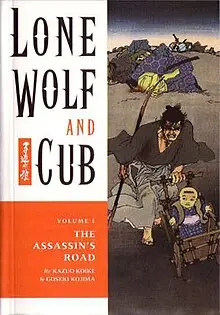
The cover is by the famous comic writer and artist Frank Miller
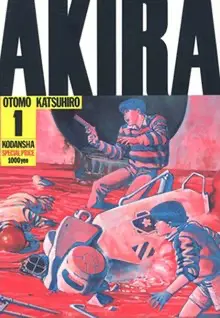
The cover of AKIRA Vol.1

Graphic Novel version of Mai, the Psychic Girl
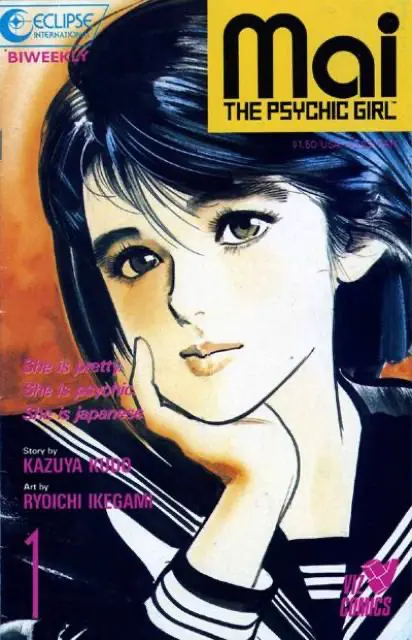
Serialization version of Mai, the Psychic Girl

Hyoe Narita started as an editor at Shogakukan Inc. for women’s magazines and manga for eight years from 1988. In 1996, Narita moved on to work for VIZ Media, LLC (San Francisco, California, USA) and eventually served as the Executive Vice President. There, he founded and became the first editor-in-chief of North American SHONEN JUMP. From 2012 to 2017, Narita was the President of Viz Media Europe with offices in Paris, Berlin, and Lausanne. Simultaneously, he served as the Vice President of the Chambre de Commerce et d’Industrie Japonaise en France between 2014-2017. Narita is now President of Humony International, Inc., Chairman of FANTASISTA, INC., and Professor at the Anime and Manga Department at Kaishi Professional University.